Bid or No-Bid Decision Framework for UK SMEs
Stop bidding on everything and qualify opportunities through four gates before writing.
Sponsored by Askjonty
- Written by
- Tender Intelligence Editors
- Published
- November 6, 2026
- Reading time
- 9 min read
What this covers
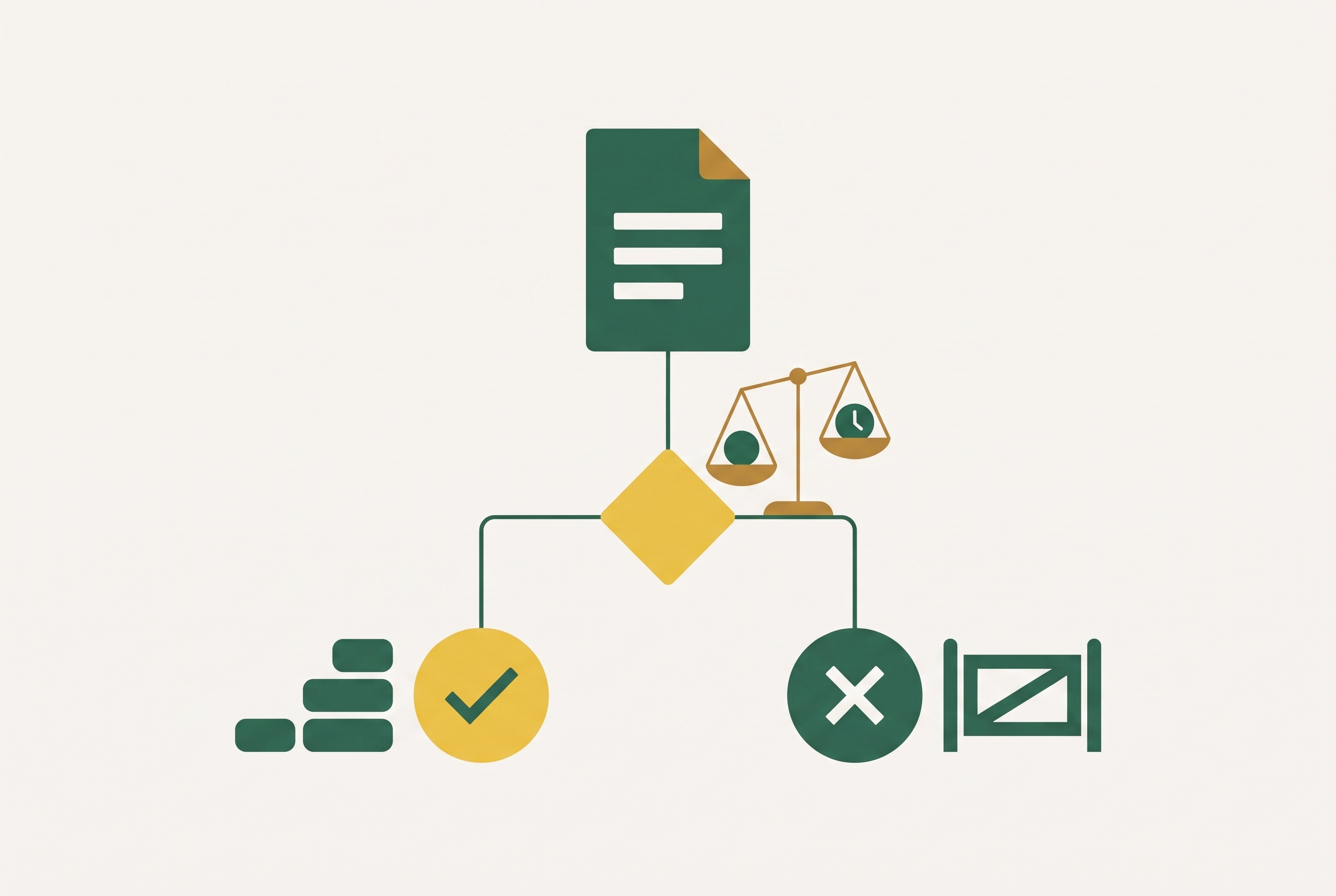
A bid/no-bid framework for UK SMEs is a discipline for choosing which public sector opportunities deserve scarce time and expertise. Its purpose is to build a sustainable pipeline by filtering opportunities through four gates, beginning before the tender documents arrive and committing to writing only when access, evidence, economics and capacity support the decision.
Why most UK SMEs lose before they write a word
The volume instinct turns a tender alert into a writing assignment before anyone has established whether the contract is worth pursuing. Bidding on everything vaguely relevant spreads the team thin, leaving less time to tailor evidence or challenge weak answers. More submissions do not necessarily produce more awards.
The cost extends beyond the bid writer. Technical leads are pulled away from live contracts, other responses fall behind, and senior reviewers get drafts too late to improve them. For an SME whose delivery specialists also support bids, that trade-off can weaken both the submission and existing client work. The business must assess its chances of winning and delivering profitably before committing to answer the tender.
What the UK public procurement market actually looks like for SMEs in 2026
The BCC & Tussell SME Procurement Tracker 2026 reports that direct public sector spend with SMEs reached its highest share of all public procurement in six years in 2025. Local government accounts for the largest slice of SME spending, the NHS for a material portion, and central government for a smaller share. Choosing which buyers to target must therefore be part of the commercial strategy.
Sector differences sharpen that choice. Construction and engineering, ICT and defence have substantially different SME shares, so a cleaning or catering business is not navigating the same competitive landscape as an IT firm. A policy in force from 4 February 2026 gives local authorities in England scope to reserve certain below-threshold competitions for local or UK-based suppliers. For locally rooted businesses, this changes which opportunities may be accessible. A useful market map must therefore distinguish buyer, sector and procurement route.
What the Procurement Act 2023 and 2026 thresholds change about which tenders are even in scope
The Procurement Act 2023 came into force on 24 February 2025, replacing the previous public contracts, utilities, concessions, and defence and security procurement regulations. The applicable regime is the first legal filter. The Act does not cover devolved Scottish authorities, which follow their own procurement regulations through Public Contracts Scotland. An SME targeting Scottish buyers must account for that distinction.
When opportunities are checked against the 2026 thresholds, the contract values include VAT. A council contract that appears below the sub-central threshold before VAT may therefore trigger full Act procedures. Below-threshold regulated contracts require a tender notice on the Central Digital Platform before advertising elsewhere, and a separate suitability stage before tenders is not permitted.
The Act also removes three potential eligibility barriers. Buyers cannot demand audited accounts from suppliers not legally required to have them, require contract performance insurance to be in place before award, or insist on a previous contract with that particular authority. Most Advantageous Tender has also replaced Most Economically Advantageous Tender, with wider public benefit including social value and innovation part of the assessment landscape.
Pipeline notices provide an earlier decision point. Bodies that expect to spend above the relevant level must publish notices within the required period after the year starts, listing the larger contracts they plan over the next 18 months. A planned procurement notice can precede a short tender window. Its appearance is therefore a cue to begin qualification.
Why the bid/no-bid decision must happen before the documents arrive
Reading documents, joining an internal call, talking to delivery colleagues and gathering case studies all take up capture time. By the time those tasks are complete, the business has already invested in the opportunity. That investment can make rejection harder to defend internally, even when basic eligibility or commercial fit remains unresolved. The deadline then adds pressure to continue.
The structural remedy is to separate identification from production. At first alert, the business decides whether to monitor. Early qualification leaves time for buyer conversations, eligibility checks and evidence gathering without assuming that a bid will follow. Later gates can then test information that was unavailable at the start. The gates are not extra bureaucracy, but a way to make early decisions repeatable and defensible.
Gate one — awareness: whether a tender is worth tracking at all
The awareness gate allocates attention. It checks buyer type, service category, geography, contract type, likely timing and any obvious eligibility restriction. This is deliberately a light filter. A notice containing “software”, “cloud”, “data” or “support” is not necessarily a fit for the business merely because those words appear in its offer.
Buyer fit also needs an initial check. Councils, NHS trusts and central government departments differ in how they evaluate bids, the patterns of who already holds their contracts and the evidence they expect. Where the scope is clearly outside capability or delivery geography is impossible, the decision should stop here, with the reason recorded. An opportunity that passes goes into a workflow for tracking.
Gate two — pursuit: whether to invest time understanding the opportunity
The pursuit gate authorises active intelligence-gathering. It examines the likely route to win, prior buyer engagement, incumbent strength, evidence of need and the fit with the firm’s actual offer. An adjacent service is not necessarily a deliverable service. Where an incumbent is embedded, pursuit needs visible evidence of dissatisfaction or a structural reason for change rather than an assumption that the buyer wants a replacement.
Route access can outweigh otherwise strong fit. An IT support firm may suit a council service-desk requirement but still be unable to pursue it if access depends on a framework lot it cannot use. Technical relevance cannot open a closed route. The procedure also affects how intelligence can be gathered, because the Act’s competitive flexible procedure allows buyers to structure engagement differently from an open procedure.
Prior buyer conversations can reveal the underlying driver behind the published requirement. Their absence is a warning. Where a conversation or clarification could change the assessment, the decision should remain conditional. That status needs a specific information gap and a named person responsible for resolving it. Otherwise, “conditional” becomes an unexamined yes.
Gate three — bid: the commitment decision before a word is written
The bid gate commits the business to production expenditure. Mandatory eligibility comes first and cannot be averaged against strategic appeal. If a required condition cannot be met, the bid stops. Strong technical capability does not compensate for missing mandatory evidence, just as a persuasive response cannot repair an inaccessible procurement route.
The team must check the bid against the tender requirements. These may include case studies of the right scope and value band, turnover requirements or the ability to meet specified insurance levels at the required stage. Financial checks belong at this commitment stage. They must also distinguish the buyer’s eligibility test from the SME’s own concern about becoming too dependent on one contract. When checking insurance, the team must follow the Act’s rule that buyers cannot require contract performance cover to be in place before award.
Evidence fit then checks whether there is proof to back up the planned answers. Relevant case studies must go beyond describing broadly similar work and give proof that the buyer can identify. The same rule applies when social value is part of the evaluation. A claim that the team hopes to substantiate during drafting is an unresolved gap. The commitment decision should rest on evidence available to support the response, rather than confidence that suitable material will emerge.
Commercial viability extends beyond headline contract value. Margin, mobilisation costs, ongoing staffing and the opportunity cost of capacity must be considered over the full term. A three-to-five-year commitment that ties up delivery resources unprofitably is not commercially attractive because it increases revenue. Heavy price weighting is also a warning where the SME cannot compete on cost. Unlimited liability or punitive KPIs that create unacceptable exposure are reasons to stop here, before award.
Finally, the team must have capacity to produce a strong response without compromising existing clients. Delivery capability and bid-writing availability are different tests. Strategic alignment, evidence, competitive positioning and buyer knowledge may all support pursuit, yet insufficient production time can still defeat the bid. A rejection at this gate should record the specific reason, so the business can distinguish a permanent mismatch from a gap the business should close before a future opportunity.
Gate four — submit: the final compliance check before the response goes in
A decision to write does not establish that the resulting response is safe to submit. The final gate checks every mandatory answer, attachment, declaration, pricing component, page limit, formatting rule and deadline. A technically strong response can still fail before its quality is evaluated.
A named reviewer who was not involved in drafting is best placed to challenge details that have become familiar to the writing team. The review must also test whether the business can defend its claims. AI-drafted content, case study data and policy commitments need verification against the tender and sign-off from someone accountable for them. Submission follows that review, rather than becoming automatic because production is complete.
Building a scoring matrix that produces a defensible decision, not a convenient one
A scoring matrix makes the reasons for a judgement clear, but only if each score must be backed by evidence. Six useful dimensions are market fit, buyer fit, route fit, evidence fit, timing fit and commercial fit. Each needs a defined failure mode. Otherwise, a favourable number can conceal a different interpretation from every person in the meeting.
Weights should reflect the business’s actual constraints. For SMEs new to public procurement, route fit and evidence fit often need more weight because rules that block access and a lack of proof can stop them putting forward a credible bid. Failures to meet mandatory requirements must be kept out of the average score.
Decision bands can then govern the allocation of resources. Illustratively, an opportunity below the chosen threshold receives an automatic no-bid with the reason recorded. A mid-range opportunity proceeds only with director-level sign-off and a named plan to close gaps, while an opportunity above the upper threshold qualifies for committed bid resources. The firm should calibrate them against its own past decisions and results.
The record must connect the decision to the eventual outcome. The Act’s assessment summaries give bidders their own scores and the winning bidder’s scores, providing evidence for reviewing qualification assumptions. A loss in a particular category can indicate that the corresponding dimension needs a different weight or a stricter evidence standard. Tools are more useful when they expose their reasoning, link to the source notice and separate route and evidence checks from keyword matching.
How the framework compounds over time and what the first few bids are actually for
A selective pipeline creates more time for each credible submission. A business winning four contracts from fewer bids has a higher win rate than one reaching the same result through a larger volume of attempts. The benefit is not only arithmetic. More time for evidence and review supports stronger responses, while fewer repeated, poorly targeted losses reduce frustration across the team.
That improvement should not be confused with immediate awards. For cleaning, security and grounds SMEs, the path from first submission to first award can typically take nine to eighteen months. The first three bids are usually training, and getting them in on time and learning from post-award feedback help make bid four stronger. Many service-sector SMEs win their first call-off on bid four to seven, often through a framework or Dynamic Market they joined earlier. Entry to those routes is itself an upstream bid/no-bid decision.
The commercial record should therefore track how much bidding costs against contract value, the win rate by buyer type and route, and what the business learns from both wins and losses. Those measures reveal whether the filter is improving selection or merely reducing activity. They also show which capability gaps warrant investment before another similar tender appears. A well-considered no-bid reserves the capacity that makes a justified yes worth pursuing.
This article is sponsored by Askjonty.